IESc Seminar Series: “Ecological and evolutionary drivers of immune variation in the wild” By Dr. Cansu Çetin
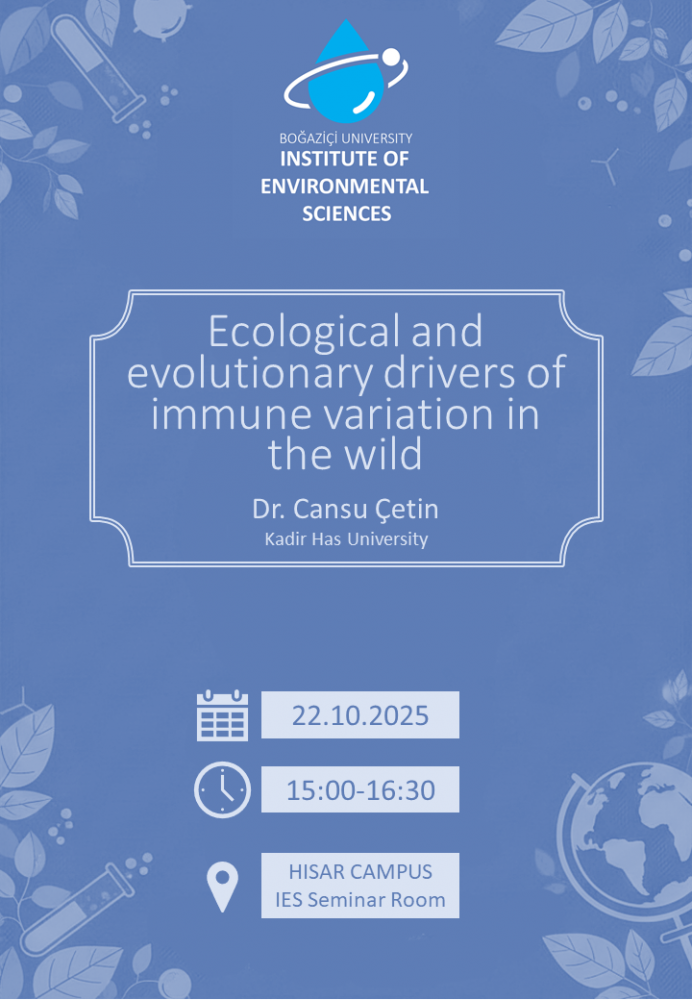
Institute of Environmental Sciences Seminar Series
“Ecological and evolutionary drivers of immune variation in the wild”
by Dr. Cansu Çetin
Kadir Has University
We cordially invite you to our seminar “Ecological and evolutionary drivers of immune variation in the wild”, to be held by Dr. Cansu Çetin, Kadir Has University.
When: 22 October 2025, Wednesday, 15:00-16:30
Where: Institute of Environmental Sciences Seminar Room (Hisar Campus E-Block)
Contact: pinar.ertor@bogazici.edu.tr for any questions.
Abstract:
Parasites pose a severe threat to organisms by reducing their fitness. The immune system is the primary barrier against infections. However, immune activity varies among individuals in the wild. The genetic properties underlying immune traits determine the capacity of populations to adapt to changing parasite pressures. In this seminar, I will talk about genetic and phenotypic variation in immune diversity. First, I will focus on my work on populating genetics of hermaphroditic freshwater snails, where I examined how demographic history and mating system affect genetic diversity and structure in natural populations. Then, using high marker density genotyping (ddRAD-Seq), I will discuss whether among-individual variation in immune activity of snails had an additive genetic basis in one of the populations. The results suggest context-dependent evolutionary potential in oxidative defense, as reflected by temporal changes in additive genetic variance.
Short bio:
 Dr. Cansu Çetin has received her undergraduate degree from the Department of Molecular Biology and Genetics, Boğazici University, and her Masters’ degree on population genetics of the marbled crab from the Institute of Environmental Sciences, Bogazici University. Dr. Çetin has a PhD degree from the Department of Environmental System Science, ETH Zurich, where she studied ecological and genetic components of immune variation in natural populations of freshwater snails. She carried out her post-doc studies at the Jagiellonian University in Krakow, Department of Biology. Dr. Çetin’s research interests include the drivers of genetic and phenotypic variation in several aquatic organisms and host-parasite interactions. She worked with various organisms including crabs, cichlid fish, freshwater snails with their trematode parasites, and amphibians.