- English
- Türkçe
IESc Seminar Series: “Political Economy and Geopolitics of Critical Minerals in a Decarbonising World" by Dr. Mehmet Metehan Çiftçi
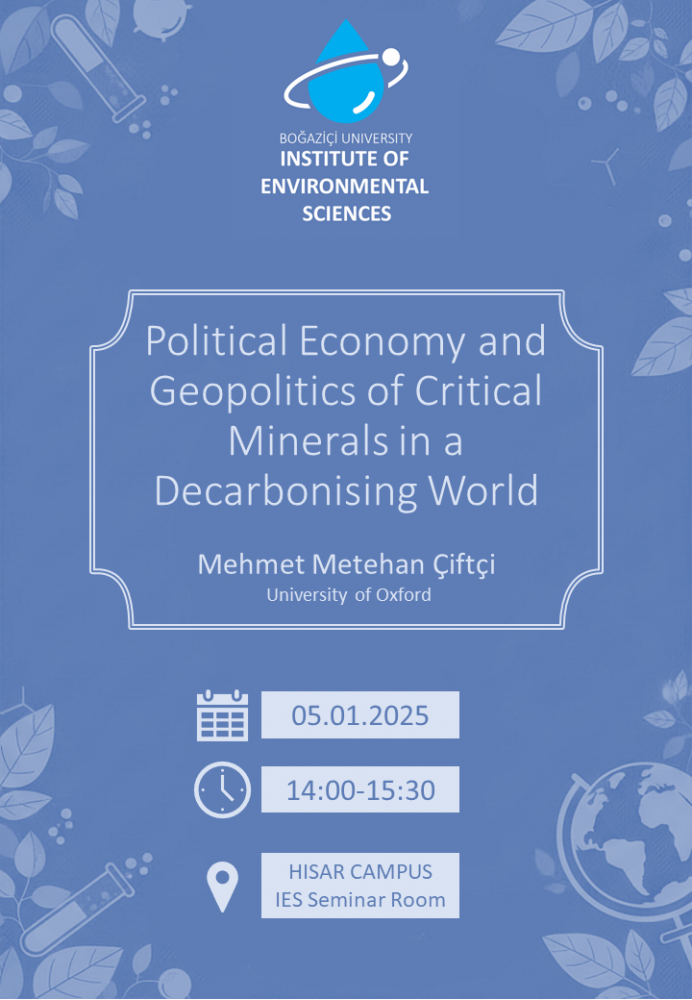
Monday, January 5, 2026
Institute of Environmental Sciences Seminar Series
“Political Economy and Geopolitics of Critical Minerals in a Decarbonising World”
by Dr. Mehmet Metehan Çiftçi
University of Oxford
We cordially invite you to our seminar “Political Economy and Geopolitics of Critical Minerals in a Decarbonising World” to be held by Dr. Mehmet Metehan Çiftçi, University of Oxford
When: 5 January, 2026, Monday, 14:00-15:30
Where: Institute of Environmental Sciences Seminar Room (Hisar Campus E-Block)
Contact: pinar.ertor@bogazici.edu.tr for any questions.
Abstract:
The rapid acceleration of climate mitigation policies has placed critical minerals at the centre of contemporary energy transitions. Materials such as lithium, cobalt, rare earths and copper are increasingly framed as indispensable for renewable energy systems, electrification and digital infrastructure. Yet the notion of ‘criticality’ is not merely a technical classification based on geological scarcity or supply risk. It is a political and economic construct shaped by industrial strategy, geopolitical competition and assumptions about growth, security and technological pathways. This seminar examines how critical raw materials are defined, prioritised and governed within climate policy frameworks and what this means for global patterns of extraction.
Building on this foundation, the seminar explores the socio-environmental impacts of mining and their implications for environmental economics and governance. Mineral extraction remains associated with profound ecological disruption, social conflict and distributive injustice, particularly in regions that supply materials for low-carbon transitions elsewhere. The discussion highlights how conflicts around mining expose tensions between climate objectives, development narratives and local forms of environmental value.
The seminar then turns to circularity as a partial response to these challenges. Recycling, reuse and material efficiency are increasingly promoted as ways to reduce primary extraction and associated harms. However, circularity has physical, temporal and political limits, especially given projected demand growth. The analysis therefore treats circular economy strategies not as a substitute for extraction but as a reconfiguration of material flows that reshapes power relations, responsibilities and expectations across supply chains.
Finally, the seminar examines novel approaches to mining and resource governance, including emerging forms of extraction linked to geothermal systems, unconventional deposits and frontier environments. These approaches present potential opportunities for regions such as the Caribbean to engage with energy transitions in ways that differ from historical extractive models. At the same time, they raise significant challenges, including legal uncertainty, risks of reproducing resource curse dynamics and acute environmental concerns exemplified by debates around deep sea mining. The seminar concludes by reflecting on how critical minerals governance might be reimagined to align climate action with socio-environmental justice and more equitable development trajectories.
Short bio:
 Mehmet Metehan Ciftci is part of the ReSET project at the University of Oxford, that looks at the role that critical minerals found beneath volcanoes can play in enabling the energy transition. He holds a PhD from the University College London Institute for Sustainable Resources. His key research themes include geopolitics and geoeconomics of critical minerals, environmental justice, the resource curse and material circularity. Prior to his PhD, Mete worked as business advisor at the British Embassy in Türkiye, completed his MSc in International Political Economy at the London School of Economics and Political Science and his BA in International Relations at Galatasaray University.