- English
- Türkçe
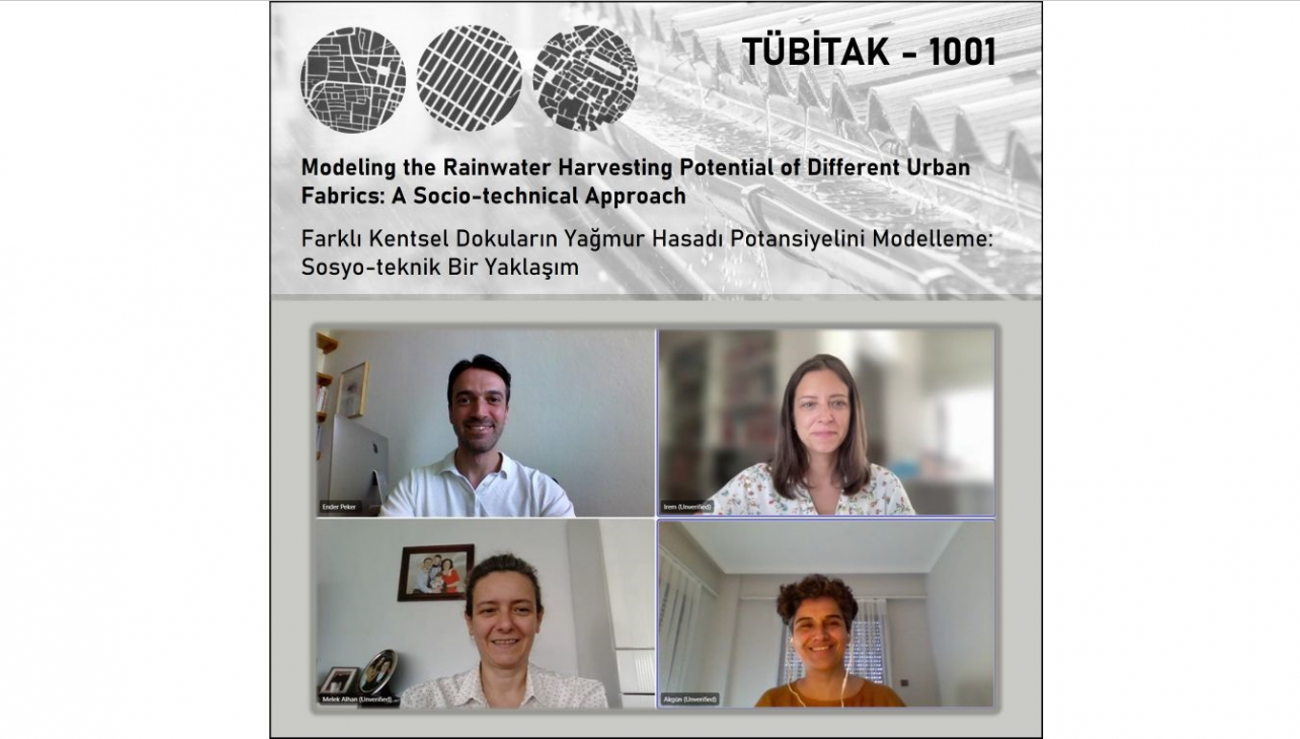
New TÜBİTAK-funded project titled “Modeling the rainwater harvesting potential of different urban patterns: A socio-technical approach”
Tuesday, October 14, 2025
We are pleased to announce the launch of a new TÜBİTAK-funded project titled “Modeling the rainwater harvesting potential of different urban patterns: A socio-technical approach” (Project No: 125Y016).
The project is led by Assoc. Prof. Dr. Ender Peker (METU), with Assist. Prof. Dr. Irem Daloğlu Çetinkaya (Boğaziçi University) Dr. Akgün İlhan (Boğaziçi University), and Prof. Dr. Melek Kazezyılmaz Alhan (İstanbul Univeristy – Cerrahpaşa) as members of the research team. Collaborating closely with Kadıköy Municipality and other local stakeholders, the project addresses two urgent urban water challenges intensified by climate change: (1) the sustainable use of diminishing water resources and (2) safe management of increasingly intense rainfall events.
Rainwater harvesting (RWH) presents a dual solution by both supplementing water supply and reducing stormwater runoff. Despite its historic relevance, there is limited scientific research in Türkiye that assesses RWH’s potential in guiding urban planning, especially in relation to parcel sizes and urban typologies.
This project aims to fill this gap by developing a hydro-spatial model that quantitatively assesses rainwater harvesting potential across diverse urban forms in Istanbul’s Kadıköy district. A key strength of the project lies in its participatory approach: stakeholder workshops, actor mapping, and engagement with planners and water managers will ensure the model reflects local realities. The outcomes will inform urban planning processes and help integrate rainwater harvesting strategies into zoning and development policies.
By offering a decision-support tool grounded in both technical data and social context, this research aims to improve urban resilience, reduce reliance on centralized water resources, mitigate flood risks, and contribute to more sustainable water use in cities. The results are expected to provide valuable insights not only for local municipalities but also as a reference for other regions and countries facing similar water management challenges.