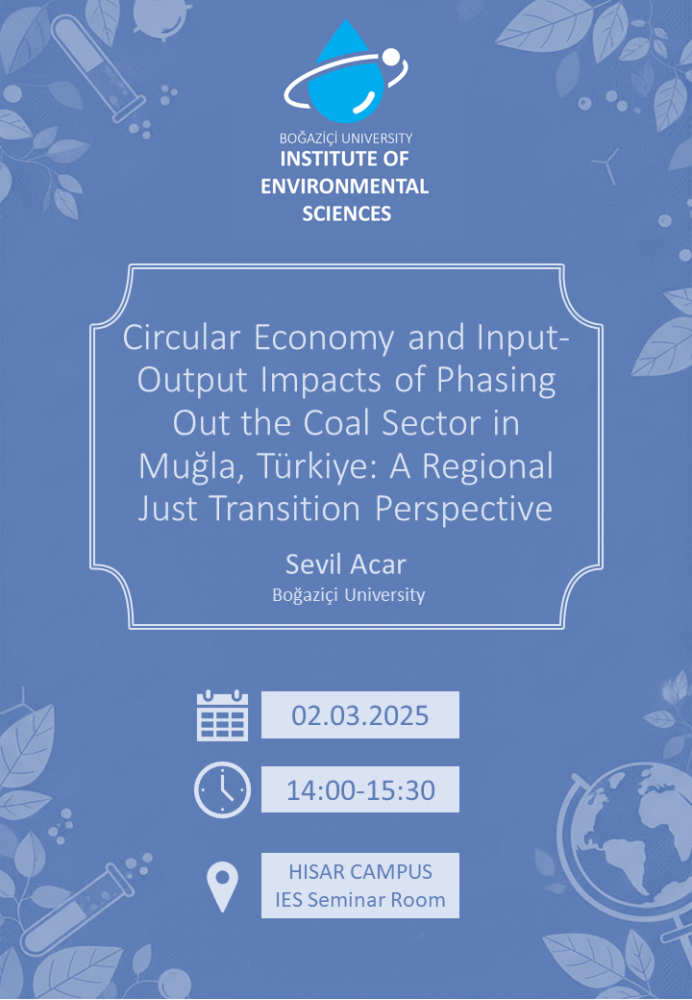
IESc Seminar Series: “Circular Economy and Input-Output Impacts of Phasing Out the Coal Sector in Muğla, Türkiye" by Prof. Dr. Sevil Acar
Institute of Environmental Sciences Seminar Series
“Circular Economy and Input-Output Impacts of Phasing Out the Coal Sector in Muğla, Türkiye: A Regional Just Transition Perspective”
by Prof. Dr. Sevil Acar
Boğaziçi University
We cordially invite you to our seminar “Circular Economy and Input-Output Impacts of Phasing Out the Coal Sector in Muğla, Türkiye: A Regional Just Transition Perspective” to be held by Prof. Dr. Sevil Acar, Boğaziçi University
When: 2 March, 2026, Monday, 14:00-15:30
Where: Institute of Environmental Sciences Seminar Room (Hisar Campus E-Block)
Contact: pinar.ertor@bogazici.edu.tr for any questions.
Abstract:
This study evaluates the economic and environmental implications of phasing out the coal sector and discontinuing subsidies for both coal mines and coal-fired power plants in Muğla, Türkiye, with a focus on key metrics such as output, value-added, employment, and greenhouse gas (GHG) emissions. The analysis proceeds in two distinct phases. Initially, it explores the direct effects of removing investment incentives for coal mining and capacity payments to thermal power plants within the electricity market capacity mechanism on regional economic indicators and environmental outcomes. Subsequently, it examines three alternative scenarios wherein these subsidies are used as a just transition fund and redirected towards greener energy technologies, investments in the circular economy within selected industries, and lower-carbon sectors in the regional context. This two-pronged approach facilitates a comparative evaluation of the costs and benefits of subsidy reform from the perspective of a just transition. The findings aim to guide regional development strategies that balance economic growth with climate mitigation objectives. By elucidating the distributional and environmental trade-offs associated with coal subsidy removal and the reallocation of funds towards sustainable investments, the study provides valuable insights for designing policies that support equitable decarbonization and promote circular economies at the local level.
Short bio:
 Sevil Acar works as Professor of Economics at the Faculty of Economics and Administrative Sciences at Bogazici University, Türkiye. Her research focuses on environmental and resource economics, particularly sustainable development indicators, climate change, and the resource curse. Awarded a Swedish Institute scholarship, she conducted doctoral research at the Centre for Environmental and Resource Economics (CERE), Umeå University, Sweden. She is Lead Author for the Intergovernmental Science-Policy Platform on Biodiversity and Ecosystem Services (IPBES) 2nd Global Assessment, Regional Assessment for Europe and Central Asia Assessment, and the Transformative Change Assessment. Her articles appeared in various journals, including Structural Change and Economic Dynamics, Ecological Economics, and Energy Policy. She also authored and co-edited three books (The Curse of Natural Resources: A Developmental Analysis in A Comparative Context; Macroeconomics of Climate Change in a Dualistic Economy; Handbook of Green Economics).